
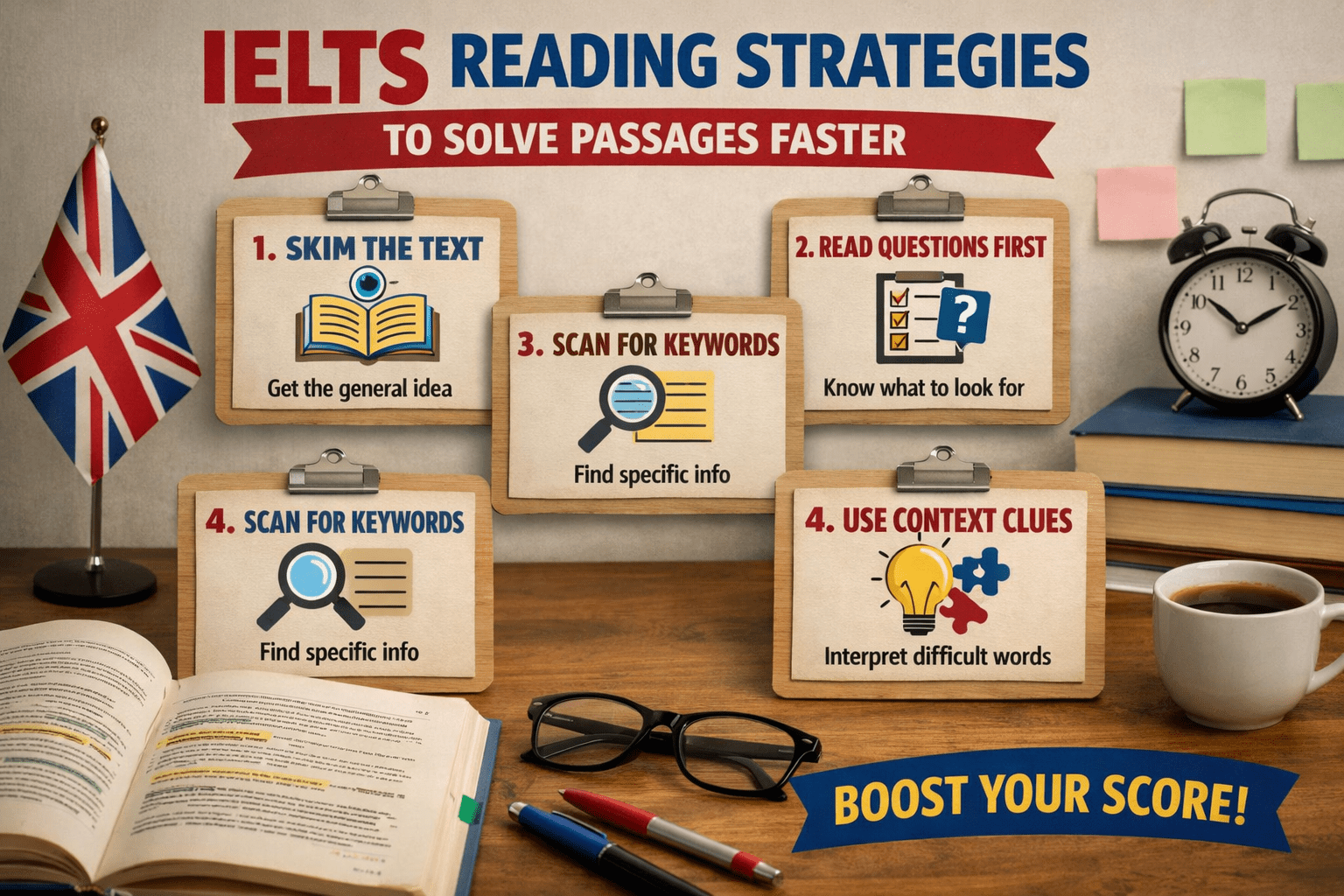
IELTS Reading Strategies to Solve Passages Faster
Struggling to finish the IELTS Reading test within 60 minutes? The problem is often not your English level—it is how you manage the passage, questions and time.
The right IELTS Reading strategies can help you find answers faster without sacrificing accuracy. Instead of reading every word, learn how to skim for the main idea, scan for specific information, recognise paraphrasing and handle different question types.
In this guide, you’ll learn practical IELTS Reading tips to help you solve passages faster and improve your Reading performance.
IELTS Reading Test Format
The IELTS Reading test has:
-
3 sections
-
40 questions
-
60 minutes
-
Different question types, including Multiple Choice, Matching Headings, True/False/Not Given and completion questions. (ielts.org)
You need to balance two things:
Speed + Accuracy
Reading quickly is not useful if you are choosing the wrong answers.
6 IELTS Reading Strategies to Solve Passages Faster
1. Don’t Read Every Word
One of the biggest mistakes students make is reading the entire passage slowly before looking at the questions.
Instead, first understand the structure and main idea of the passage, then use the questions to identify where you need to read carefully.
A simple process is:
Question → Keywords → Locate → Read carefully → Answer
This prevents you from spending too much time on information that isn’t relevant to the question.
2. Use Skimming and Scanning
These are two essential IELTS Reading skills.
Skimming means reading quickly to understand the main idea and structure of a passage.
Focus on:
-
First sentences of paragraphs
-
Headings
-
Repeated ideas
-
Names and important terms
Scanning means searching for specific information.
Look for:
-
Names
-
Dates
-
Numbers
-
Places
-
Unusual words
For example, if a question mentions Professor Smith, scan the passage for “Smith” or a related reference rather than rereading the entire text.
3. Look for Paraphrasing, Not Just Keywords
Finding an exact keyword in the passage does not always mean you have found the answer.
IELTS frequently tests whether you can recognise the same meaning expressed differently.
For example:
Question:
The number of international students increased rapidly.
Passage:
The number of overseas students rose significantly.
Here:
-
international students → overseas students
-
increased → rose
-
rapidly → significantly
This is why learning synonyms and recognising paraphrasing is important for IELTS Reading.
4. Use the Right Strategy for Each Question Type
Don’t solve every question in exactly the same way.
True / False / Not Given
Look for evidence in the passage.
-
True → the statement agrees with the passage
-
False → the statement contradicts the passage
-
Not Given → the passage does not provide the information
Don’t use your personal knowledge to decide the answer.
Matching Headings
Focus on the main idea of the paragraph, not one example or detail.
Ask:
“What is this entire paragraph mainly about?”
Fill-in-the-Blanks
Check:
-
The word limit
-
Grammar
-
Spelling
-
Whether the answer fits the meaning of the sentence
Following the instructions is essential because answers that exceed the stated word limit can be marked incorrect.
5. Don’t Spend Too Long on One Question
Getting stuck on one difficult question can damage your entire Reading score.
If you cannot find the answer after checking the relevant section:
Mark it → move on → return later.
A useful time target is:
| Passage | Target time |
|---|---|
| Passage 1 | 15–17 minutes |
| Passage 2 | 19–20 minutes |
| Passage 3 | 23–25 minutes |
Passage 3 may require more careful reading, so leaving additional time for it can be useful.
The exact timing is flexible—what matters is finishing all 40 questions within the 60-minute test.
6. Improve Vocabulary Through Context
You don’t need to understand every word in an IELTS Reading passage.
When you see an unfamiliar word, first ask:
Do I need this word to answer the question?
If not, continue reading.
When the word is important, use the surrounding sentences to understand its likely meaning.
Also keep a vocabulary list containing:
-
New word
-
Meaning
-
Synonym
-
Example sentence
This helps you recognise different ways IELTS may express the same idea.
The Best IELTS Reading Method to Practise
Try this simple Locate → Read → Answer method:
1. Read the question
Understand exactly what information you need.
2. Find the keywords
Look for names, numbers, dates or important concepts.
3. Locate the information
Scan the passage and look for synonyms or paraphrases.
4. Read around the answer
Don’t rely on one matching word. Read enough context to confirm the meaning.
5. Answer and move on
Don’t spend several minutes trying to make one answer perfect.
With regular practice, this process can become much faster and more natural.
Common IELTS Reading Mistakes
Avoid these mistakes if you want to improve your Reading speed:
-
Reading every word from beginning to end
-
Searching only for exact keywords
-
Spending too long on one question
-
Using outside knowledge
-
Ignoring the word limit
-
Confusing False with Not Given
-
Choosing an answer because it “sounds right” without checking the passage
Your goal is not to finish the passage as quickly as possible.
Your goal is to find the correct answers efficiently.
How to Improve Your IELTS Reading Score
Practice should include both timed tests and mistake analysis.
After each practice test, record:
-
Which questions you got wrong
-
Why you got them wrong
-
How long you spent
-
Which question types caused problems
For example, if you consistently lose marks in Matching Headings, spend more time practising that specific question type instead of simply taking more full tests.
If you are struggling to improve despite regular practice, personalised feedback can help identify the specific areas affecting your performance.
Need help with IELTS preparation?
IELTS With Viv offers structured IELTS preparation and personalised training to help students work on their weaker skills and prepare for their target band score.
Frequently Asked Questions
How can I solve IELTS Reading passages faster?
Use skimming and scanning, identify keywords, look for paraphrases and avoid reading every word. Practise locating the relevant section before reading it carefully.
Should I read the questions first in IELTS Reading?
You can preview the passage first to understand its structure, then use the questions to locate specific information. The best approach can vary by question type.
How much time should I spend on each IELTS Reading passage?
A practical starting point is around 15–17 minutes for Passage 1, 19–20 minutes for Passage 2 and 23–25 minutes for Passage 3. Adjust this according to your strengths.
How do I improve True/False/Not Given questions?
Look for direct evidence in the passage. True means the statement agrees with the text, False means it contradicts the text, and Not Given means the information is not provided.
Is vocabulary important for IELTS Reading?
Yes, but you don’t need to know every word. Focus on understanding meaning from context and recognising synonyms and paraphrases.
Conclusion
The key to solving IELTS Reading passages faster is not simply reading faster.
It is learning to:
Skim → Scan → Recognise paraphrases → Find evidence → Answer → Move on
Practise these skills regularly, track your mistakes and work on the question types that cause you the most problems.
If you need structured support to improve your IELTS Reading performance, explore IELTS With Viv courses or contact us for personalised IELTS preparation.