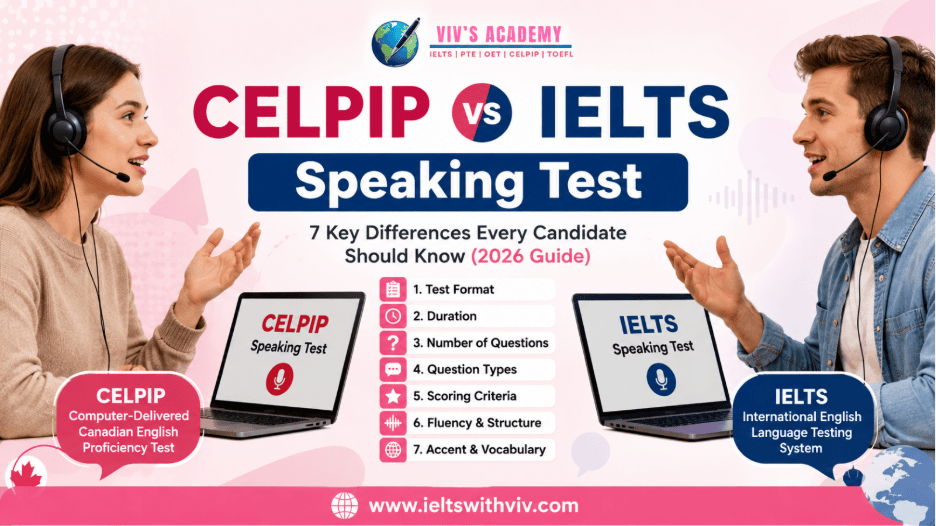

If you are planning to study, work, or apply for permanent residency in Canada, choosing the right English language test is an important decision. One of the biggest questions candidates ask is CELPIP vs IELTS Speaking Test – which speaking test is easier, more practical, and better suited for your goals?
Although both exams measure your English communication skills, the speaking section is designed very differently. Understanding these differences can help you prepare with confidence and improve your chances of getting a higher score.
In this guide, you will learn the 7 most important differences between the speaking tests, along with a simple comparison table and expert tips to help you choose the right exam.
Why Comparing CELPIP vs IELTS Speaking Matters
Many candidates focus only on the overall exam, but the speaking section often feels the most challenging. The CELPIP vs IELTS Speaking Test comparison becomes especially important because the test format, scoring, and experience are completely different.
If your goal is Canadian immigration, understanding these differences can save you time and help you prepare more effectively.
Quick Comparison Table
|
Feature |
CELPIP Speaking |
IELTS Speaking |
|
Test Style |
Computer-based |
Face-to-face interview |
|
Duration |
15–20 minutes |
11–14 minutes |
|
Number of Tasks |
8 speaking tasks |
3 speaking parts |
|
Examiner |
Recorded responses |
Live examiner |
|
Best For |
Canada PR applicants |
Study, work, migration |
|
Scoring |
CELPIP levels |
IELTS band score |
|
Test Environment |
Quiet computer station |
Personal interview room |
7 Key Differences Between CELPIP and IELTS Speaking
- Test Format Is Completely Different
The biggest difference between CELPIP Speaking vs IELTS Speaking is the test format.
The CELPIP Speaking test format is fully computer-based. You wear headphones, listen to questions, and record your answers using a microphone. There is no face-to-face conversation.
On the other hand, the IELTS Speaking test format is an interview with a trained examiner. You answer questions naturally, just like a real conversation.
Best for: If you feel nervous talking to strangers, CELPIP may feel more comfortable.
- Number of Speaking Tasks
The CELPIP Speaking test includes 8 different speaking tasks. These tasks test your ability to communicate in everyday situations.
Some common CELPIP Speaking tasks include:
- Giving advice.
- Describe a picture.
- Talking about personal experiences.
- Expressing your opinion.
- Making predictions.
The IELTS Speaking test is simpler in structure. It has only 3 parts:
- Introduction and personal questions.
- A short speech on a given topic.
- The discussion is based on the same topic.
While IELTS has fewer sections, the conversation often goes deeper.
- Time Management Is More Important in CELPIP
Time is another major difference in IELTS vs CELPIP Speaking.
In CELPIP, every task has a fixed preparation time and a fixed speaking time. Once the timer starts, you must speak until it ends.
In IELTS, the examiner controls the conversation. If your answer is too short, they may ask additional questions. If it is too long, they may politely stop you.
This makes CELPIP more structured, while IELTS feels more natural.
- Interaction With the Examiner
One of the most noticeable differences is human interaction.
In the CELPIP Speaking test, you speak only to a computer. Your responses are recorded and evaluated later.
In the IELTS Speaking test, you interact directly with an examiner. They observe not only your words but also how naturally you communicate.
Candidates who enjoy conversations often prefer IELTS, while those who like a controlled environment may choose CELPIP.
- Scoring System Is Different
The CELPIP Speaking score is based on Canadian Language Benchmark (CLB) levels. Your performance is evaluated on clarity, vocabulary, grammar, pronunciation, and overall communication.
The IELTS Speaking section uses the familiar Band Score (0–9). Examiners assess:
- Fluency and coherence.
- Vocabulary.
- Grammar accuracy.
- Pronunciation.
Although both tests measure similar skills, the scoring scales are different. Always check which score your college, employer, or immigration program accepts.
- Everyday English vs Academic Conversation
Another important point in CELPIP Speaking vs IELTS Speaking is the type of English used.
CELPIP focuses on real-life Canadian situations, such as talking to a neighbor, making a complaint, or discussing workplace situations.
IELTS includes more open-ended discussions. In Part 3, you may be asked to explain opinions on education, technology, society, or culture.
If you are preparing for life in Canada, CELPIP often feels more practical.
- Which Speaking Test Is Easier?
There is no single answer because it depends on your personality and confidence.
Choose CELPIP Speaking if you:
- Prefer speaking into a microphone.
- Like fixed time limits.
- Want questions based on everyday situations.
- Are applying mainly for Canada PR.
Choose IELTS Speaking if you:
- Feel comfortable in face-to-face conversations.
- Enjoy discussing different topics.
- Want a more natural interview experience.
- Need IELTS for study or international opportunities.
When comparing CELPIP vs IELTS Speaking, the easier test is usually the one that matches your communication style.
CELPIP vs IELTS Speaking: Which One Should You Choose?
Here is a simple decision guide:
|
Your Goal |
Recommended Test |
|
Canada Permanent Residency |
CELPIP |
|
Canadian Citizenship |
CELPIP |
|
Study Abroad |
IELTS |
|
International Job Opportunities |
IELTS |
|
Comfortable with Computer-Based Tests |
CELPIP |
|
Prefer Face-to-Face Communication |
IELTS |
If your primary goal is Canadian immigration, many applicants choose CELPIP because it is designed specifically for Canadian English and everyday communication.
Expert Tips to Score Higher in Any Speaking Test
Whether you choose CELPIP or IELTS, these strategies can improve your performance:
- Speak clearly instead of speaking fast.
- Use natural vocabulary in your answers.
- Practice with a timer every day.
- Avoid memorized responses.
- Improve pronunciation through regular speaking practice.
- Listen carefully before answering.
- Stay calm and confident throughout the test.
Consistent practice is much more effective than memorizing difficult words.
Final Thoughts
Choosing between CELPIP vs IELTS Speaking is not about finding the easier exam – it is about choosing the test that matches your goals and speaking style.
If you are applying for Canadian immigration and prefer a computer-based experience, CELPIP is an excellent option. If you are comfortable with a live interview and need a widely accepted English test for education or global career opportunities, IELTS is a strong choice.
Before booking your exam, understand the CELPIP vs IELTS Speaking Test, practice the official format, and focus on improving your communication skills. With the right preparation, you can achieve the speaking score you need.
For expert preparation, practice resources, and personalized guidance, visit ieltswithviv
Frequently Asked Questions (FAQs)
- Which is easier: CELPIP Speaking or IELTS Speaking?
It depends on your comfort level. CELPIP is computer-based with recorded responses, while IELTS is a face-to-face interview with an examiner.
- How long is the CELPIP Speaking test?
The CELPIP Speaking test usually takes 15–20 minutes and includes 8 different speaking tasks.
- What is the format of the IELTS Speaking test?
The IELTS Speaking test format has three parts: an introduction, a short individual speech, and a discussion with the examiner.
- Is the CELPIP Speaking score accepted for Canada PR?
Yes. The CELPIP Speaking score is widely accepted for Canadian permanent residency, citizenship, and many immigration programs.
- Should I choose CELPIP or IELTS for Canada?
If your main goal is Canadian immigration and you prefer a computer-based exam, CELPIP is often the better choice. If you need a globally recognized English test for study or work, IELTS may be more suitable.
Leave a Reply